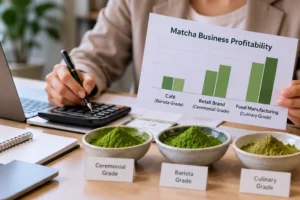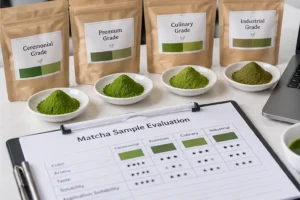
Launching a new matcha-based product is an exciting venture, but the journey from concept to market-ready can get stuck in a frustrating loop of R&D. Many brand owners find themselves buried in endless rounds of sampling, testing products that just don’t quite hit the mark. The solution to shorten R&D and sampling cycles for new matcha products1 isn't about rushing the process; it's about making your process smarter by defining your commercial goals before you ever request your first sample.
The most effective way to shorten R&D and sampling cycles for new matcha products is to shift from a vague, grade-based sourcing approach to a targeted, goal-oriented one. Instead of asking for "Ceremonial Grade," you must clearly communicate your specific application (e.g., latte, baking), desired sensory profile (color, taste), and target cost per serving to your supplier. This allows them to provide a highly curated selection, eliminating irrelevant options and accelerating your path to the right matcha.
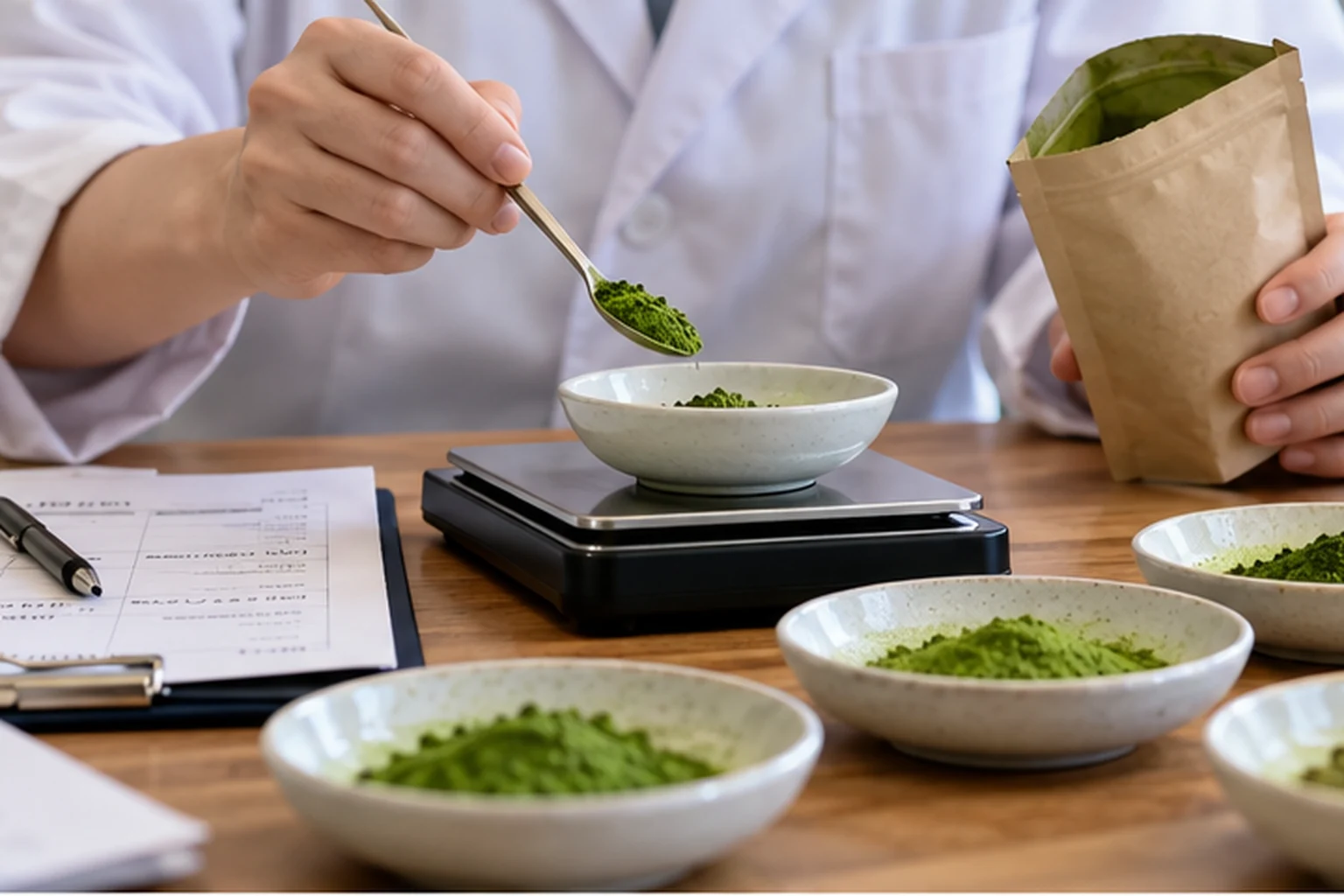
This strategic shift from "trial-and-error" to "targeted selection" is the single most important factor in a successful and efficient product launch. Let's explore why the old way of sampling is so inefficient and how you can implement this new approach to get your product to market faster.
Why Does Unfocused Matcha Sampling Extend Your R&D Timeline?
Have you ever requested samples of "the best" matcha, only to find they don't work in your final product? Perhaps the beautiful, expensive Ceremonial Grade you tested disappeared into your oat milk latte, or the color of a culinary powder turned dull after baking. This frustrating experience sends you right back to the beginning of your search.
Unfocused sampling, typically driven by vague requests for specific grades instead of commercial outcomes, is the number one cause of R&D delays. It locks you into a trial-and-error cycle that wastes time, money, and valuable momentum on testing products that were never suitable in the first place.
Dive Deeper: The Hidden Costs of an Inefficient Process
The problem often begins with a common misconception. As a supplier, a question we get constantly from new brand founders is, "Which of your grades is the best?" This leads them directly into what I call the "Best Grade Trap."
H3: The "Best Grade" Trap
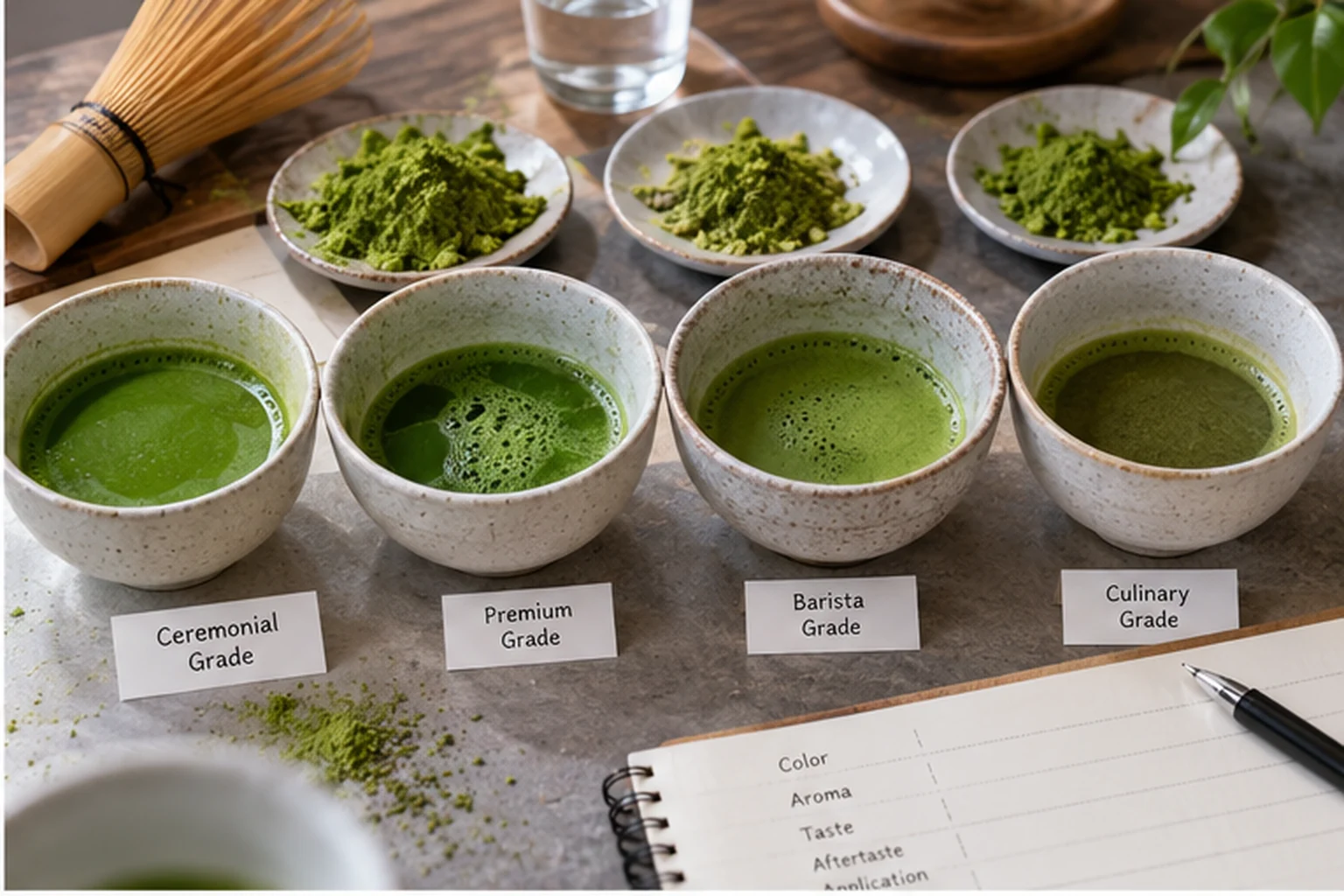
Many buyers assume that a higher grade, like Ceremonial, is universally better for all applications. While Ceremonial Grade matcha is exceptional for its intended purpose2—being whisked with water for pure tea (usucha)—it is often the wrong choice for other products.
- For Lattes: Ceremonial matcha can be too delicate3. Its subtle, nuanced flavors can be easily overpowered by milk, steamed or iced. A robust Premium Grade (like a Barista or Cafe grade) is often better, designed to deliver a strong flavor and vibrant green color that punches through milk.
- For Baking: Heat is the enemy of matcha's delicate color and flavor4. Using an expensive Ceremonial Grade in a cookie or cake is not only a waste of money but can lead to disappointing results. A quality Culinary Grade is formulated to offer better color stability5 and a more assertive flavor profile that survives the baking process.
When you ask for a grade without context, you are essentially guessing. A good supplier can't guide you effectively, so you end up testing products based on a name rather than their performance in your specific use case.
H3: The Compounding Cost of Repeated Testing
Every failed sampling round has tangible and intangible costs6 that add up quickly, significantly delaying your launch.
| Cost Type | Description | Impact on Your Project |
|---|---|---|
| Hard Costs | Shipping fees for samples, cost of the matcha itself (if not free), and the ingredients used for testing (milk, flour, sugar, etc.). | These are direct, measurable expenses that drain your R&D budget with each additional round. |
| Time Costs | The hours your team spends preparing, testing, and evaluating each sample. This includes product developers, chefs, and decision-makers. | This is lost productivity. Your team could be working on packaging, marketing, or other launch-critical tasks. |
| Opportunity Costs | Every week spent re-sampling is a week your product is not on the market generating revenue7 and capturing market share. | This is the most significant cost. A three-month delay could mean missing a key seasonal window or allowing a competitor to launch first. |
A client once came to us after six months of sampling with various suppliers. They had tested over a dozen "premium" matcha powders for their new bottled beverage, but none met their color and stability requirements. Their mistake? They kept asking for "premium matcha" without ever explaining that it needed to remain suspended and vibrant in a liquid for weeks. Had they led with the application, we could have narrowed their search to just two suitable options in our first conversation.
How Can You Define Your Commercial Goals to Shorten Matcha Product R&D?
You understand that being specific is key, but you're not a tea master. What information does a supplier actually need to help you? You don't have to be a matcha expert to get expert results; you just need to become an expert on your own product goals.
To truly shorten your matcha product R&D, you must clearly communicate the "job-to-be-done" for the matcha. We guide our most successful clients to define four key pillars before they request a single sample: the application, sensory targets, cost structure, and any competitive benchmarks.
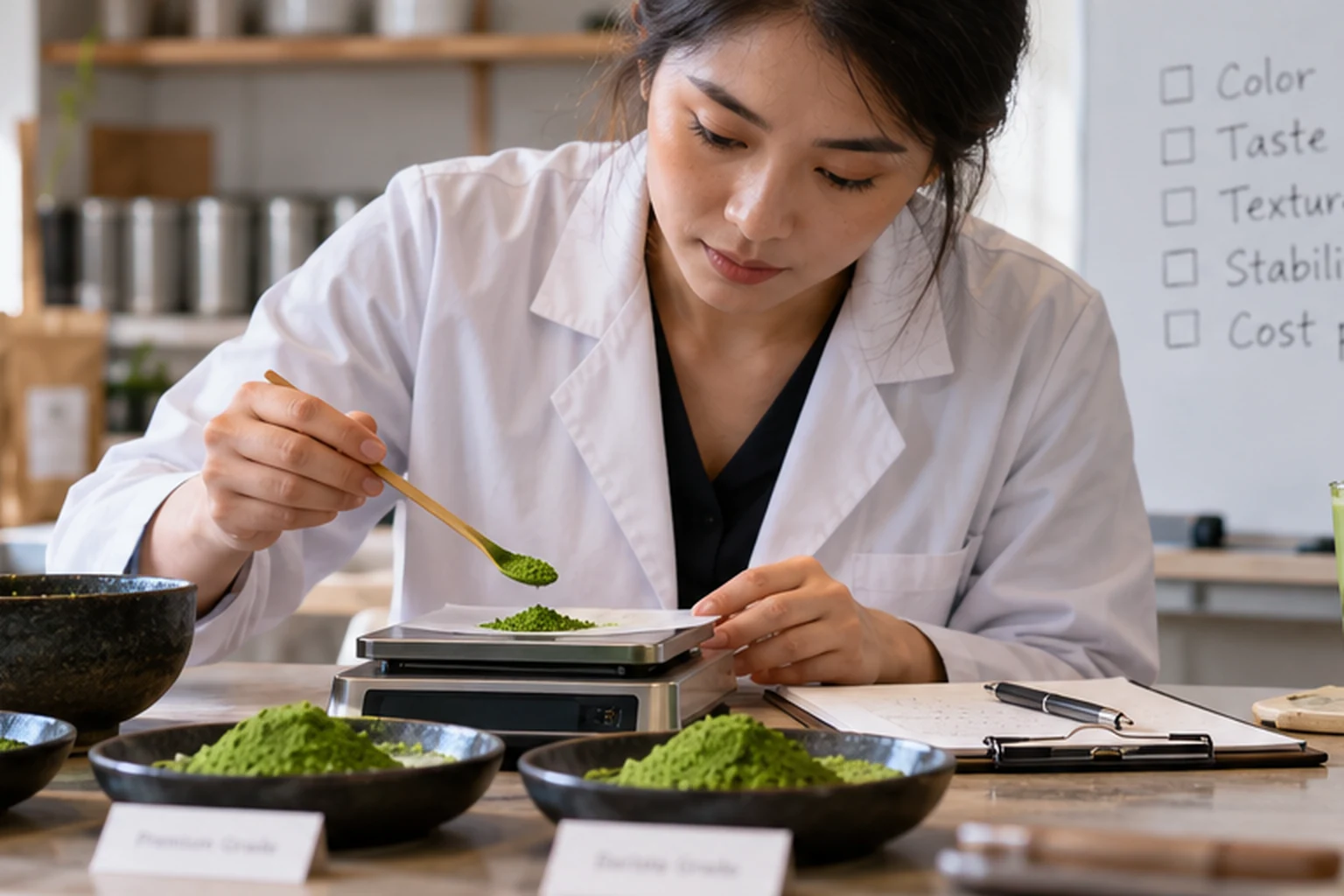
Dive Deeper: The Four Pillars of a Targeted Sourcing Brief
Building your sourcing process around these four pillars transforms you from a passive sample requester into a proactive product developer. It allows a supplier to act as a consultant, using their expertise to match your specific need with the right product from their portfolio.
H3: 1. The Application: What Are You Making?
This is the most critical piece of information. The physical and chemical demands placed on the matcha vary wildly between applications. Be precise.
- Is it a beverage? Specify the type. A matcha latte with dairy milk behaves differently than one with oat or almond milk. An RTD (ready-to-drink) bottled tea has unique requirements for solubility and suspension.
- Is it a baked good? A cookie, a croissant, or a chiffon cake all have different baking times and temperatures8, affecting which matcha will retain its color and flavor best.
- Is it another application? For ice cream, you need a matcha that creates a smooth texture and doesn't become gritty when frozen. For a chocolate bar, the matcha needs to blend seamlessly with cocoa butter.
H3: 2. The Sensory Profile: What Should It Look, Smell, and Taste Like?
Go beyond "tastes good." Describe the ideal customer experience.
- Color: Is "vibrant green" your top priority? Or is a more subdued, natural green acceptable? For lattes, color is often a key purchasing driver. For a filled pastry, it might be less critical.
- Flavor: Are you aiming for a deep, savory umami flavor? Or a stronger, slightly bitter "matcha" profile that can stand up to sugar? Low bitterness is key for pure tea, but a little astringency can be desirable to cut through the sweetness of a dessert.
- Texture/Mouthfeel: For beverages, a fine particle size is essential to avoid a gritty or sandy texture. For industrial food processing, specific mesh sizes might be required for machinery compatibility.
H3: 3. The Cost Structure: What's Your Target Cost Per Serving?
Sharing your target cost isn't about negotiating the lowest price; it's about ensuring commercial viability. A supplier needs this information to recommend a product that fits your business model.
A matcha that costs $0.80 per serving might be perfectly acceptable for a premium $7 latte at a specialty coffee shop. However, that same cost would be unsustainable for a mass-market cookie that retails for $1.50. Be upfront about your cost-in-use targets. This prevents both you and the supplier from wasting time on samples that are beautiful but commercially impossible for your project.
H3: 4. The Benchmark: What Are You Improving Upon?
Providing context about your market helps a supplier zero in on the perfect product even faster.
- Are you trying to create a dupe of a popular product from a major chain? Tell the supplier. "We want a matcha latte that looks and tastes similar to Brand X's, but using organic ingredients."
- Are you improving an existing product of your own? "Our current matcha baked good loses too much color. We need something with better heat stability."
- Are you creating something entirely new? Describe the niche you're aiming for. "We're launching a high-end ceremonial grade for our tea subscription box, focused on a smooth mouthfeel and zero bitterness."
How Do You Turn Your Goals into a Structured Sampling Request?
You've done the strategic work and defined your four pillars. Now, how do you package this information into a request that gets you fast, accurate results? A vague, one-line email will get you a generic response, but a structured brief will command attention and position you as a serious partner.
A structured sampling request is a concise document that clearly outlines your application, sensory goals, cost targets, and market context. It empowers your supplier to move beyond being a simple order-taker and become a valuable development consultant, dramatically helping to shorten R&D and sampling cycles for new matcha products.
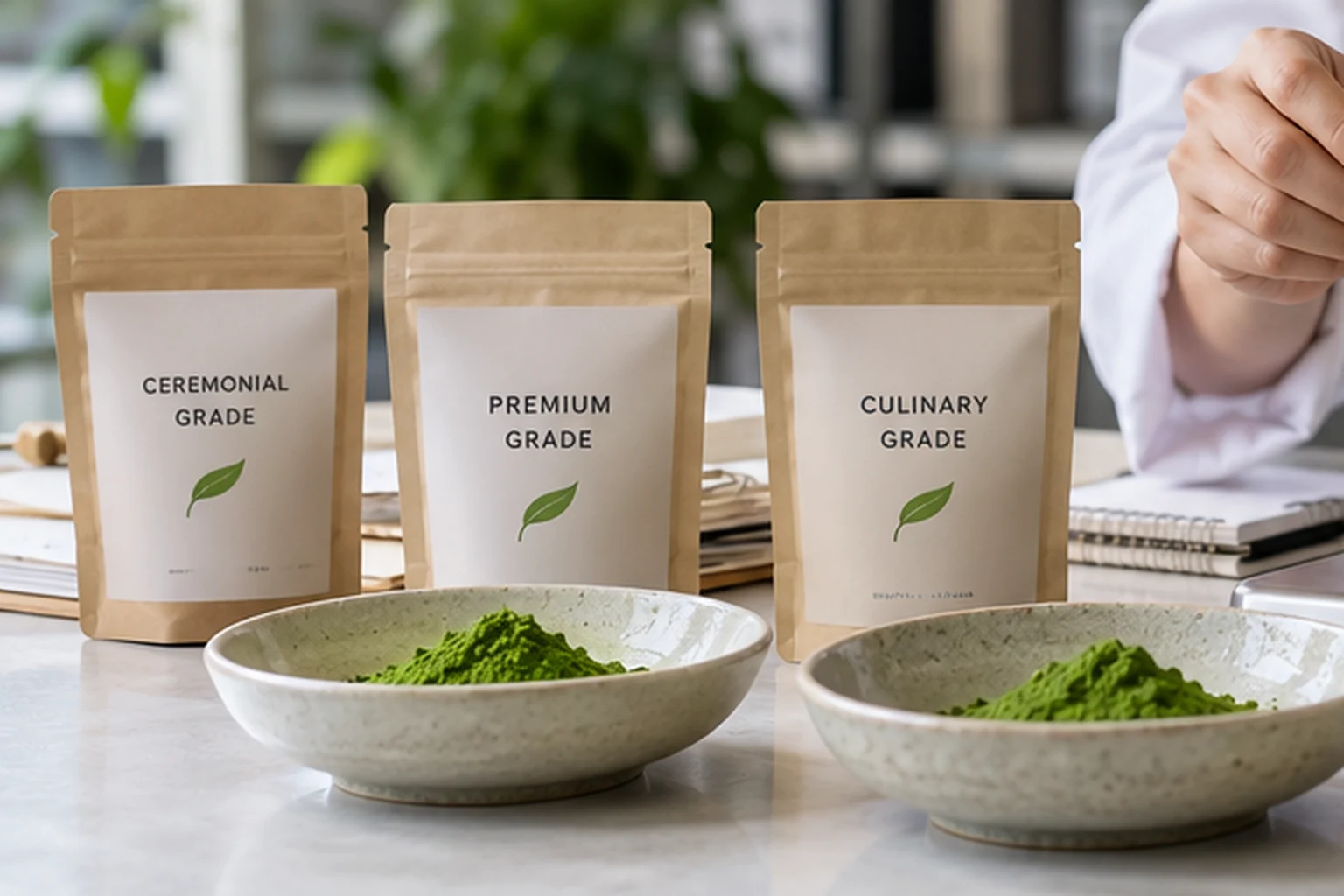
Dive Deeper: From Vague Inquiry to Actionable Brief
The difference between a weak request and a strong one is clarity and context. Let's compare two approaches.
The Ineffective Request: "Hi, We are developing a new matcha product and are interested in your company. Can you please send us samples of your Ceremonial and Premium Grade matcha? Also, please provide your price list and MOQ. Thanks"
This request puts all the work on the supplier to guess what you need. You will likely receive their standard samples, which may or may not be relevant, kicking off a long and frustrating back-and-forth.
Now, contrast that with a structured, goal-oriented brief.
The Effective Request: "Hi, We are a coffee shop chain developing a new flagship Iced Oat Milk Matcha Latte for our spring menu.
Our key goals are:
- Application: Iced latte with oat milk. Needs to blend easily without clumping and hold its color.
- Sensory: A vibrant, 'Instagrammable' green color is our top priority9. The flavor must be smooth and creamy, with low bitterness, to complement the oat milk.
- Cost Target: Our target ingredient cost is between $0.45 and $0.55 per 16oz serving (using 4g of matcha).
- Benchmark: We want to offer a noticeably greener and smoother product than our local competitor, Cafe Z.
Based on these requirements, which 1-2 products from your portfolio would you recommend we sample first? We're looking to make a decision in the next 3 weeks."
This brief is a game-changer. In our experience at Lvyinbio, a client who sends a request like this is on the fast track to success. It allows us to immediately disqualify 90% of our products and focus only on the one or two that are a perfect fit. We can then send a highly targeted sample package with specific notes on why each one was chosen for their goal. This single step can replace months of random sampling.
Frequently Asked Questions
What's the biggest mistake brands make when sampling matcha?
The single biggest mistake is asking for a specific grade (e.g., "Ceremonial") without providing any context about the application. This leads to testing unsuitable products, wasting time and money. Always lead with your end product—the "job-to-be-done"—not a grade name.
How many matcha samples should I test at once?
Ideally, you should only test a highly curated selection of 1-3 options from a supplier who understands your goals. If you find yourself testing 5, 10, or more samples, it's a clear sign that your sourcing process is unfocused. A smaller, targeted selection is far more efficient.
Should I tell a supplier my target cost?
Yes, absolutely. A professional B2B supplier needs this information to recommend a commercially viable option10. It's not about getting the "cheapest" product; it's about finding the right product that fits your business model and quality standards, preventing you from falling in love with a sample you can't afford.
Can I just use Ceremonial Grade for everything to ensure quality?
This is a common but costly misconception that actually extends R&D cycles. Ceremonial Grade is formulated for drinking with water and is often too delicate and expensive for lattes, baking, or other food applications. Using a grade specifically designed for your application (e.g., a Barista or Culinary grade) will almost always yield better results and a healthier margin.
Conclusion
The power to shorten R&D and sampling cycles for new matcha products is entirely within your control. It requires a strategic shift away from the slow, costly process of unfocused sampling. By taking the time to define your commercial goals upfront—clarifying your application, sensory profile, cost targets, and market position—you transform your sourcing process11. Presenting this clear, structured brief to your supplier enables them to become a partner in your success, not just a vendor. This targeted approach eliminates guesswork, reduces risk, and accelerates your journey from a great idea to a successful product on the shelf.
If you are ready to build an efficient sourcing process and find the perfect matcha for your brand's next innovation, we are here to help. Contact our team with your project details, and let’s work together to create a targeted sampling plan that gets you to market faster.
"Food scientists cut research time, accelerate ... - Waystation AI", https://www.waystationai.com/blog/food-scientists-cut-research-time-accelerate-product-development-with-ai/. A study on food product development efficiency found that clear initial specifications significantly reduce development timelines by minimizing trial-and-error cycles. Evidence role: general_support; source type: research. Supports: Defining commercial goals before requesting samples can streamline R&D processes.. Scope note: The study may focus on general food product development rather than matcha-specific cases. ↩
"Elevate Your Tea Brand with Ceremonial Grade Matcha", https://matchasourcing.com/ceremonial-grade-matcha/. According to tea preparation guides, Ceremonial Grade matcha is specifically formulated for traditional Japanese tea ceremonies, where it is whisked with water to create usucha. Evidence role: definition; source type: encyclopedia. Supports: Ceremonial Grade matcha is traditionally used for whisking with water to make usucha.. ↩
"Estimating the sensory-associated metabolites profiling ... - PMC", https://pmc.ncbi.nlm.nih.gov/articles/PMC10654251/. Tea experts agree that Ceremonial Grade matcha is best appreciated in pure tea form, as its subtle flavors are often masked in milk-based drinks. Evidence role: expert_consensus; source type: research. Supports: Ceremonial matcha's delicate flavor profile is less suitable for milk-based beverages.. ↩
"Effect of storage temperature on the antioxidant activity and ...", https://pmc.ncbi.nlm.nih.gov/articles/PMC7406592/. Research on tea polyphenols indicates that high temperatures degrade chlorophyll and catechins, leading to diminished color and flavor in matcha. Evidence role: mechanism; source type: research. Supports: Heat alters the chemical composition of matcha, affecting its color and flavor.. Scope note: The study may focus on general tea polyphenols rather than matcha specifically. ↩
"Effect of storage temperature on the antioxidant activity and ...", https://pmc.ncbi.nlm.nih.gov/articles/PMC7406592/. Studies on matcha grades indicate that Culinary Grade matcha contains higher levels of heat-stable compounds, making it suitable for baking applications. Evidence role: mechanism; source type: research. Supports: Culinary Grade matcha is formulated for better color and flavor stability under heat.. Scope note: The study may not cover all Culinary Grade matcha formulations. ↩
"Benchmarking biopharmaceutical process development and ...", https://pmc.ncbi.nlm.nih.gov/articles/PMC7531566/. A report on food R&D processes found that inefficient sampling can increase development costs by up to 30% and delay launches by several months. Evidence role: statistic; source type: research. Supports: Failed sampling rounds can lead to significant financial and time costs in product development.. Scope note: The report may focus on general food R&D rather than matcha-specific cases. ↩
"The Federal Research and Development (R&D) Tax Credit", https://www.congress.gov/crs-product/R48848. Economic analyses of product development show that launch delays can reduce first-year revenue by up to 20% in competitive markets. Evidence role: statistic; source type: research. Supports: Sampling delays can lead to significant revenue loss and missed market opportunities.. Scope note: The analysis may focus on general product launches rather than matcha-specific cases. ↩
"Effect of storage temperature on the antioxidant activity and ...", https://pmc.ncbi.nlm.nih.gov/articles/PMC7406592/. Research on matcha in baking applications shows that heat stability is influenced by grade and formulation, with Culinary Grade performing best in high-temperature environments. Evidence role: mechanism; source type: research. Supports: Matcha's heat stability varies depending on the baking application.. Scope note: The research may not cover all types of baked goods. ↩
"Why is Matcha Color Important? Matcha Green Color is the ...", https://matchasourcing.com/why-is-matcha-color-important-matcha-green-color-is-the-key-to-determining-quality/. Market research on food aesthetics indicates that color plays a critical role in consumer appeal, particularly for visually-driven products like matcha lattes. Evidence role: statistic; source type: research. Supports: Vibrant green color is a significant factor in consumer purchasing decisions for matcha lattes.. Scope note: The research may focus on general food aesthetics rather than matcha-specific cases. ↩
"Lifting the Veil: The Benefits of Cost Transparency", https://www.hbs.edu/ris/Publication%20Files/15-017_f67df7f5-8336-47fc-a0c1-098838aa550d.pdf. Industry sourcing guidelines emphasize that clear cost targets help suppliers tailor recommendations to client needs, improving efficiency. Evidence role: expert_consensus; source type: institution. Supports: Cost transparency enables suppliers to recommend commercially viable options.. ↩
"Set Effective Goals to Improve Organizational Performance", https://www.umassglobal.edu/blog-news/how-to-measure-organizational-performance. Educational resources on supply chain management highlight that goal-setting reduces inefficiencies and enhances supplier collaboration. Evidence role: general_support; source type: education. Supports: Clear goal-setting improves the efficiency and focus of sourcing processes.. ↩