Struggling to choose a wholesale matcha partner? The market is filled with suppliers all claiming to have the "best" quality, leaving you to navigate a confusing landscape of grades, specs, and certifications. Making the wrong choice can lead to an inconsistent product, a failed import inspection, or a matcha that simply doesn't perform in your recipe, costing you significant time, money, and brand reputation.1 A systematic bulk matcha supplier evaluation focused on the right questions is the solution to finding a partner who aligns perfectly with your business goals.
A successful bulk matcha supplier evaluation is not a search for a single "best" product, but a risk assessment framework to match a supplier's quality, compliance, and production capacity to your specific business application. This involves defining quality relative to your end-use, verifying compliance for your target market, and confirming consistency through structured inquiry and multi-batch sampling.
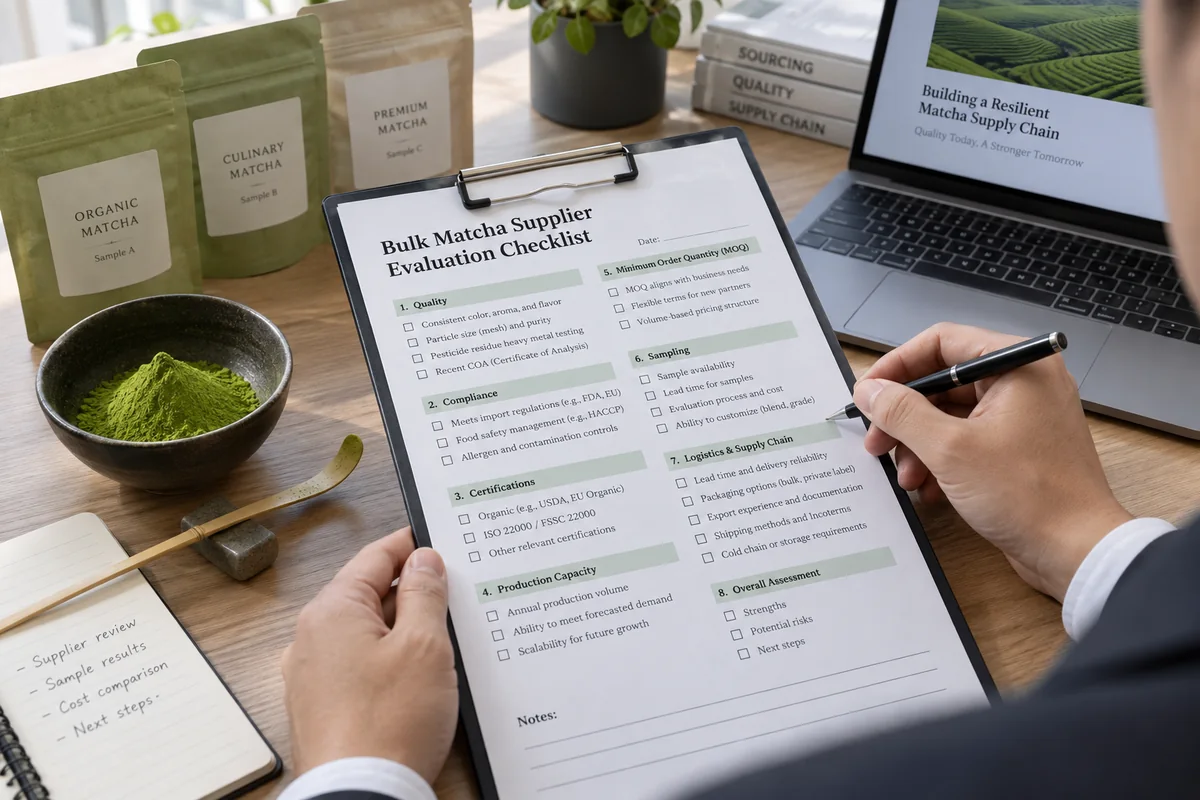
This checklist isn't a simple scorecard. Instead, it's a guide to inquiry. It will equip you with the critical questions to ask potential suppliers, helping you look beyond marketing claims and assess their true capabilities as a long-term partner. Let’s dive into the three pillars of a thorough evaluation: quality, compliance, and capacity.
How Do You Evaluate Matcha Quality for Your Specific Application?
Every supplier claims to offer "high-quality" matcha, but this term is almost meaningless without context. You might be tempted to source the most expensive ceremonial grade, only to find its delicate flavor is lost in your lattes or baked goods. To avoid overspending or choosing the wrong product, you must learn to define and test for quality based on your end-use.
The key is to deconstruct "quality" into specific, measurable attributes that matter for your application. A premium tea brand has vastly different quality priorities than a commercial bakery or a café chain.2
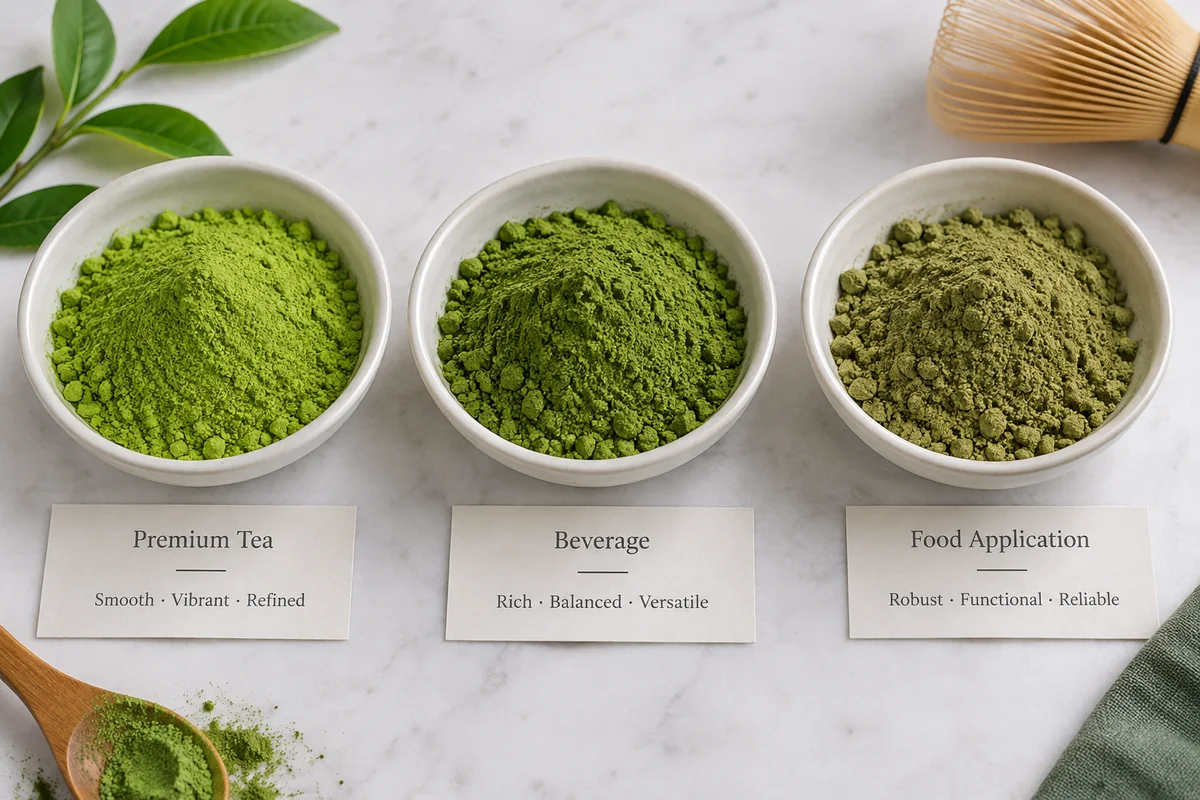
For Beverage Brands & Cafés
When developing a matcha latte, iced tea, or other signature drink, your customers' first impression is visual.
- Color Vibrancy with Milk: How does the matcha look when mixed with dairy or plant-based milk? A common issue we see is a matcha that looks vibrant as a powder but turns a dull, swampy green in a latte. A good beverage-grade matcha, like our Barista Reserve, is specifically cultivated and processed to maintain a bright green hue even when diluted.3
- Mixability (Dispersibility): Does the powder dissolve easily in hot or cold liquid without excessive clumping? Poor mixability slows down your baristas and creates an unpleasant, gritty texture for the customer. This is often related to particle size (mesh) and electrostatic properties.
- Flavor Balance: The matcha needs a robust flavor profile that is bold enough to stand up to milk and sweeteners without being overly bitter or astringent. You're looking for a balance of rich, vegetal notes with a smooth finish.
For Tea Brands & Direct-to-Consumer Retailers
If you are selling pure matcha for traditional preparation (usucha or koicha) or as a premium retail product, your customers are connoisseurs. Their definition of quality is far more nuanced.
- Umami & Sweetness: This is the hallmark of high-grade ceremonial matcha. It's a savory, brothy, and deeply satisfying flavor with a naturally sweet finish, derived from shade-growing that boosts L-theanine and chlorophyll content.
- Lack of Bitterness: Excessive bitterness or astringency is a sign of lower-quality leaves, improper processing, or oxidation. Premium ceremonial matcha should be exceptionally smooth.
- Fine Particle Size: A stone-milled matcha should have a particle size of 5-10 microns, feeling as fine as talcum powder.4 This creates the stable, creamy foam characteristic of well-prepared matcha.
- Vibrant, Deep Green Color: The color should be a brilliant, almost electric green, indicating freshness and high chlorophyll content.
For Food Manufacturers & Bakeries
When incorporating matcha into baked goods, ice cream, chocolate, or other food products, the evaluation criteria shift dramatically. Aesthetics take a backseat to performance and consistency.
- Flavor Potency & Heat Stability: The matcha flavor needs to be strong enough to not get lost among other ingredients like flour, sugar, and fat. More importantly, how does the color and flavor hold up after baking or processing? A good culinary-grade matcha is designed for color retention and a robust flavor profile.
- Batch-to-Batch Consistency: This is non-negotiable in food manufacturing. The matcha you buy in June must have the same color, flavor, and functional properties as the matcha you buy in December. Any variation can alter your final product, leading to customer complaints and waste. During a bulk matcha supplier evaluation, always ask how they guarantee this consistency.
- Cost-Effectiveness: For industrial applications, price is a major factor. Sourcing a high-cost ceremonial grade is wasteful and unnecessary, as its delicate nuances will be destroyed by heat and other ingredients. A reliable culinary grade provides the necessary performance at a commercially viable price point.
| Application | Top Quality Priority | Secondary Priorities | What to Avoid |
|---|---|---|---|
| Café / Latte Brand | Vibrant color in milk | Mixability, balanced flavor | Dull, brownish color; high bitterness |
| Premium Tea Brand | Rich umami, low bitterness | Fine particle size, vibrant color | Gritty texture, astringent aftertaste |
| Food Manufacturer | Batch-to-batch consistency | Strong flavor, heat stability | Delicate ceremonial grades, inconsistent specs |
What Compliance Documentation is Essential in a Bulk Matcha Supplier Evaluation?
A potential supplier sends you an impressive folder of certificates. But are they the right ones? A shipment rejected by customs because of non-compliant documentation is a supply chain catastrophe.5 A core part of your bulk matcha supplier evaluation is ensuring the supplier can provide documents that meet the specific regulations of your target import market.
You must request market-specific compliance documents, including pesticide and heavy metal analysis, microbial testing, and relevant certifications. Crucially, it's your responsibility to verify that these documents align with your country's import regulations and consumer protection laws.
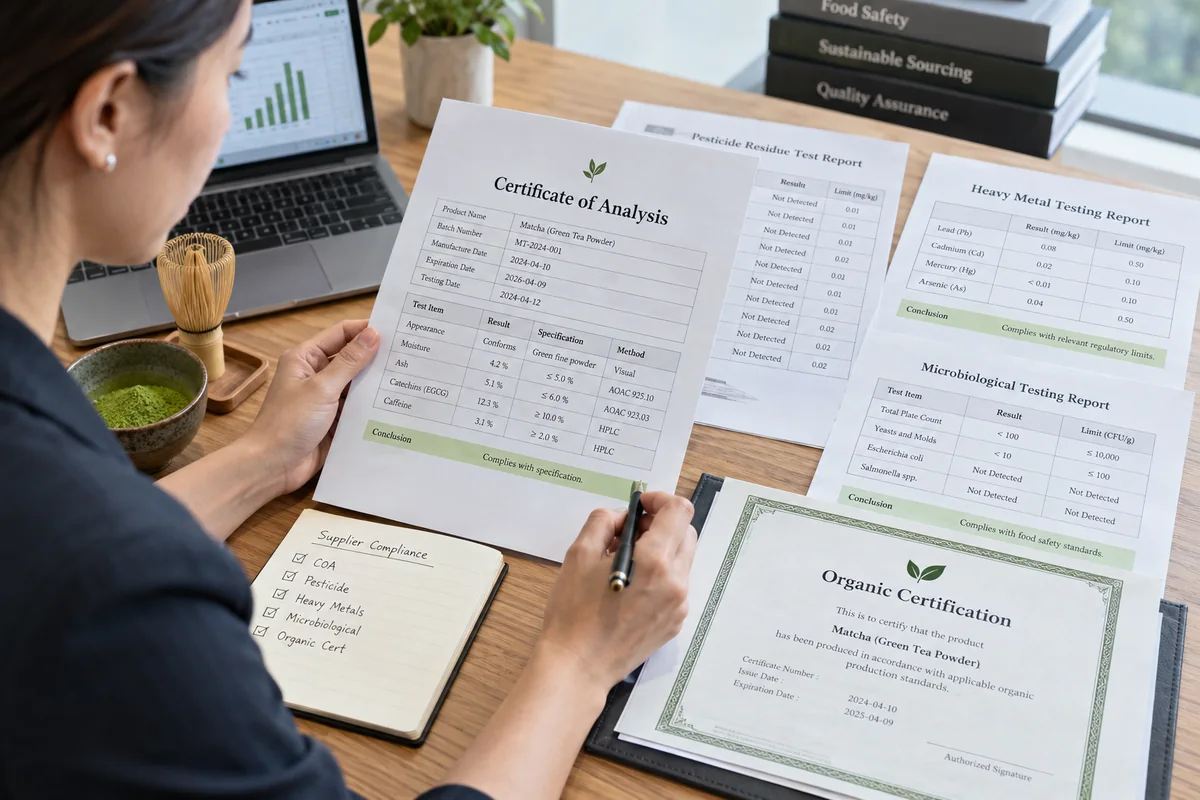
Core Food Safety Documentation
A reputable supplier should be able to provide a Certificate of Analysis (COA) for each batch upon request. This document provides results from third-party lab testing. Don't just accept any COA; scrutinize it.
Here are the key tests you should look for:
- Heavy Metal Analysis: Tea plants can absorb heavy metals from the soil.6 Request tests for Lead (Pb), Arsenic (As), Cadmium (Cd), and Mercury (Hg). The maximum residue limits (MRLs) for these vary significantly.7 For example, the European Union has different, often stricter, limits than the FDA in the United States. You must know the limits for your market.
- Pesticide Residue Analysis: This is one of the most common reasons for rejected shipments. Ask for a multi-residue pesticide screening report. Again, the list of banned pesticides and their MRLs differs greatly between the EU, North America, and other regions. A supplier who exports globally should understand these differences and be able to provide the correct testing panel for your destination.
- Microbiological Tests: This confirms the matcha is free from harmful bacteria. Standard tests include Total Plate Count, Yeast & Mold, E. coli, and Salmonella. These are fundamental to ensuring the product is safe for consumption.
Navigating Organic & Other Certifications
"Organic" is a regulated term. A product that is certified organic in China is not automatically considered organic in the US or Europe.
- USDA NOP (for the United States): If you plan to label your product as "organic" in the US, your entire supply chain, including the supplier, must be certified to the USDA National Organic Program standard.
- EU Organic (for Europe): Similarly, for the EU market, the supplier needs to be certified by a control body recognized by the European Commission, and the product must carry the EU organic logo.
- Other Certifications: Depending on your customer base, you may also need certifications like Kosher, Halal, or food safety management system certifications like ISO 22000 or FSSC 22000. Ask the supplier which certifications they hold and request the documents for verification.
A Note on the Certificate of Analysis (COA)
When we work with a new B2B client, we make it a practice to provide a sample COA for the exact grade they are testing. This document is a snapshot of a specific production lot. It demonstrates the supplier's commitment to quality control and transparency. A strong COA comes from an accredited, independent laboratory (e.g., ISO/IEC 17025 accredited) and clearly lists the testing methods used alongside the results.
How Can You Verify a Supplier's Production Capacity and Consistency?
A supplier has passed your quality and compliance checks. Now for the final, critical test: can they deliver? A supplier might promise they can handle your large seasonal order, but if they fail to deliver on time or the quality varies between shipments, your business operations grind to a halt. This part of your bulk matcha supplier evaluation is about vetting their real-world capabilities.
To confirm a supplier's reliability, you must verify their claimed production capacity by asking specific questions about their supply chain and lead times. Furthermore, you must assess their batch-to-batch consistency by understanding their QC process and, most importantly, testing samples from different production runs.
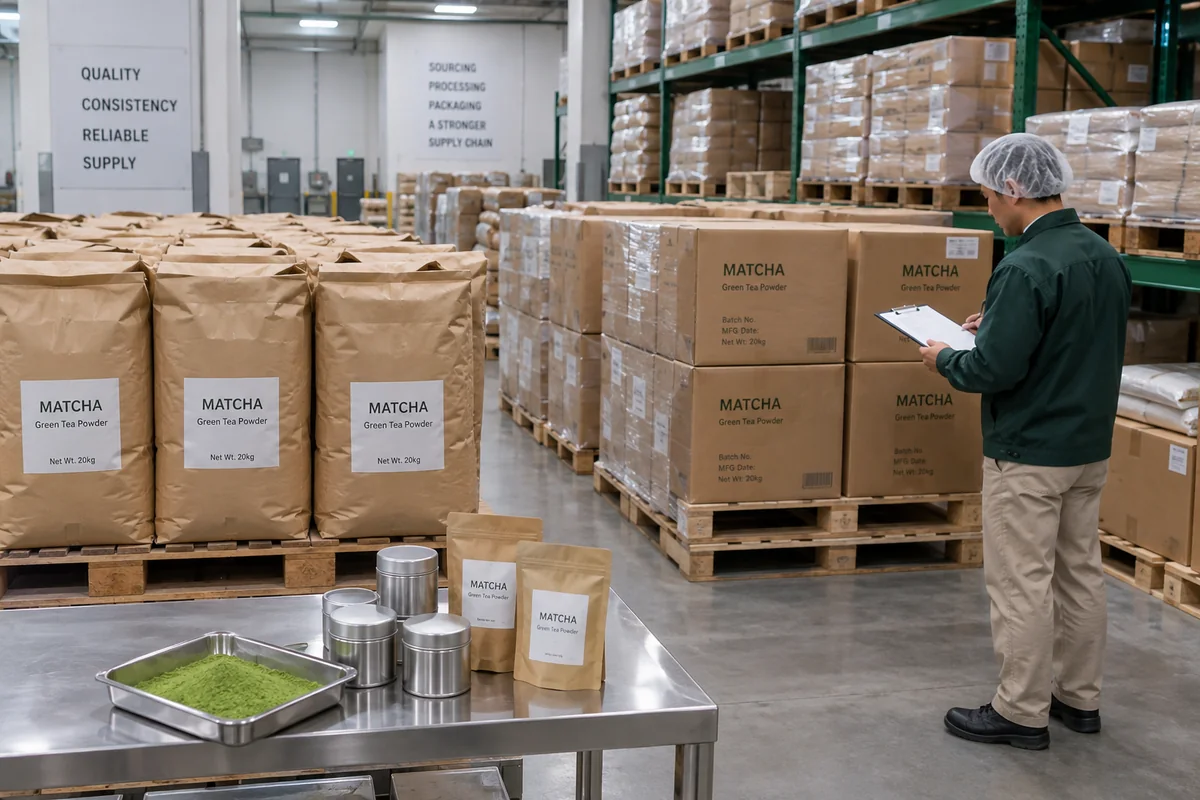
Questions to Ask About Production Capacity
Vague promises are a red flag. Get specific data to gauge their operational scale.
- "What is your total annual production volume in metric tons, and what is the capacity specifically for the grade I am interested in?" A supplier might have a large total capacity, but only a small portion may be dedicated to the high-grade ceremonial matcha you need.
- "What is your standard lead time for a new order of X kgs/tons versus a repeat order?" This helps you understand their production planning and inventory strategy. A reliable supplier should have a clear and predictable timeline.
- "Describe your supply chain. Do you own the farms, contract with specific farmers, or source from multiple regions?" This question reveals how much control they have over their raw material. A vertically integrated or long-term contract-based model often leads to better consistency.8
- "How do you mitigate supply chain risks like poor harvests, logistics delays, or other disruptions?" A mature supplier will have contingency plans, such as safety stock or diversified sourcing from different fields within the same region.
Assessing Batch-to-Batch Consistency
For any branded product, consistency is paramount. Your customer expects the matcha latte they buy today to taste and look exactly like the one they bought last month.
A common mistake we see buyers make is evaluating only a single sample. A single great sample proves nothing about long-term reliability.9 Here’s how to dig deeper:
- Request Samples from Different Batches: Ask for samples from two or three different production lots, preferably made several months apart. Prepare them side-by-side. Are the color, aroma, and taste identical?
- Review Multiple COAs: Ask for the COAs corresponding to each sample batch. Do the lab values (e.g., for color, caffeine, theanine) remain within a tight, acceptable range? This is hard evidence of process control.
- Inquire About Their QC Process: Ask them to walk you through their quality control steps. When do they test? Do they blend different harvests to achieve a consistent final product? At Lvyinbio, for our long-term clients, we often reserve specific lots of raw material to ensure that their supply for the next 6-12 months comes from the exact same harvest and blend, guaranteeing unparalleled consistency.
This level of scrutiny is essential for a successful bulk matcha supplier evaluation and for building a resilient supply chain for your brand.
Frequently Asked Questions
How do I test a matcha sample correctly?
The best way to test a sample is to prepare it exactly as your end customer will experience it. If you're developing a latte, test it in a latte with your standard milk and syrup. If it's for baking, do a small test bake. Compare multiple samples side-by-side in a single sitting to spot subtle differences.
What is a reasonable MOQ for bulk matcha?
Minimum Order Quantities (MOQs) vary widely based on the supplier and the grade of matcha. For an initial trial order of a premium or barista grade, MOQs can be as low as 10-20 kg. For large-scale industrial or wholesale distribution, suppliers may require pallet-level orders (hundreds of kgs). It's always a point of discussion.
Should I be concerned about the origin of the matcha?
Absolutely. The origin (terroir) significantly impacts the flavor profile. Japanese matcha from Uji or Nishio is known for certain characteristics, while high-quality Chinese matcha, like our supply from the high-altitude plateaus of Guizhou, is prized for its vibrant color and strong flavor profile, which performs exceptionally well in beverages and food applications. A transparent supplier will always be clear about the origin.
What's the difference between a trading company and a manufacturer?
A manufacturer typically has direct control over the farming, processing, and final production, offering greater control over quality and consistency. A trading company sources products from one or more manufacturers. While direct manufacturers can offer more control, experienced traders can provide access to a wider variety of grades and origins. The key is transparency and a robust quality assurance system, regardless of the business model.
Conclusion
A thorough bulk matcha supplier evaluation moves beyond a simple price comparison. It's a strategic process of aligning a supplier’s capabilities with your specific business needs. By focusing your inquiry on the three core pillars—application-specific quality, market-specific compliance, and proven production capacity—you transform the selection process from a gamble into a calculated business decision. Remember to define quality on your own terms, demand documentation that matches your import market, and verify consistency with multi-batch testing. This disciplined approach is the foundation for building a successful, long-term partnership that will help your brand grow.
If you are ready to find a reliable matcha partner who understands these commercial and technical nuances, we invite you to discuss your project with us. We can help guide you to the right grade and provide the necessary samples and documentation for your evaluation.
"Import Violation | Food Safety and Inspection Service", http://www.fsis.usda.gov/taxonomy/term/19. Studies on supply chain management highlight that poor supplier selection can lead to product inconsistencies, regulatory non-compliance, and financial losses for businesses. For example, a 2020 report by the International Journal of Supply Chain Management discusses the impact of supplier-related risks on operational efficiency. Evidence role: case_reference; source type: research. Supports: The risks associated with choosing an unreliable supplier, including product inconsistency, failed inspections, and financial losses.. Scope note: The source may not focus specifically on matcha suppliers but provides general insights into supplier-related risks. ↩
"Tau PET positivity in individuals with and without cognitive ...", https://pubmed.ncbi.nlm.nih.gov/40670684/. Educational resources on food science indicate that quality priorities for matcha differ by application, with beverage brands focusing on color and flavor, while bakeries prioritize heat stability and cost-effectiveness. Evidence role: general_support; source type: education. Supports: Different industries have varying quality requirements for matcha based on its intended use.. Scope note: The source may provide general insights rather than specific data on matcha. ↩
"Matcha Green Tea: Chemical Composition, Phenolic Acids ...", https://pmc.ncbi.nlm.nih.gov/articles/PMC11049459/. Research on matcha processing techniques shows that shade-growing and specific milling methods enhance chlorophyll content, contributing to a vibrant green color even when diluted. Evidence role: mechanism; source type: research. Supports: The cultivation and processing methods that help beverage-grade matcha retain its bright green color in liquids.. Scope note: The source may not focus exclusively on beverage-grade matcha but discusses general processing techniques. ↩
"Matcha Powder — Particle Size, Stone Milling, and Why ...", https://unearthed-gallery.com/blogs/founders-blog/matcha-powder?srsltid=AU7gw4VHUdfI0HP9c2cSnlawRNAIEt7gX6WvlK88srW9KPpHnaC3dP1K. Studies on matcha production indicate that traditional stone milling produces a particle size of 5-10 microns, which is essential for achieving a smooth texture and stable foam. Evidence role: statistic; source type: research. Supports: The typical particle size range for stone-milled matcha and its impact on texture.. Scope note: The source may focus on traditional methods and not account for modern milling techniques. ↩
"Globalization, Trade, and the Impact of Customs Initiatives ...", https://digitalcommons.law.mercer.edu/cgi/viewcontent.cgi?article=2862&context=jour_mlr. According to the U.S. Customs and Border Protection, incomplete or incorrect documentation is a leading cause of shipment rejections, often resulting in delays and financial losses for importers. Evidence role: case_reference; source type: government. Supports: The risks and consequences of customs rejections due to non-compliant documentation.. Scope note: The source focuses on U.S. regulations and may not cover other regions. ↩
"Accumulation of Heavy Metals in Tea Leaves and Potential ...", https://pmc.ncbi.nlm.nih.gov/articles/PMC5800232/. Research published in environmental science journals confirms that tea plants can absorb heavy metals like lead and cadmium from contaminated soil, which may pose health risks if not monitored. Evidence role: mechanism; source type: research. Supports: The ability of tea plants to absorb heavy metals from the soil and its implications for product safety.. Scope note: The findings may vary based on soil conditions and geographic location. ↩
"Assessing Heavy Metal Contamination in Food - PMC - NIH", https://pmc.ncbi.nlm.nih.gov/articles/PMC12115360/. The European Food Safety Authority and the U.S. FDA have different maximum residue limits for heavy metals and pesticides in tea, reflecting regional regulatory standards. Evidence role: statistic; source type: government. Supports: The variation in maximum residue limits for heavy metals and pesticides between different regions.. Scope note: The source may focus on general food products and not exclusively on matcha. ↩
"Working Together: Values-Based Food Supply Chain Case ...", https://smallfarms.oregonstate.edu/smallfarms/working-together-values-based-food-supply-chain-case-studies. Research in supply chain management suggests that vertically integrated models and long-term contracts improve consistency by reducing variability in raw material quality. Evidence role: general_support; source type: research. Supports: The advantages of vertical integration and long-term contracts in achieving product consistency.. Scope note: The source may not focus specifically on matcha but provides general insights into supply chain practices. ↩
"Probabilistic Approach to Multi-Stage Supplier Evaluation - PMC", https://pmc.ncbi.nlm.nih.gov/articles/PMC9409630/. Educational materials on quality assurance emphasize the importance of multi-batch testing to assess supplier reliability and consistency over time. Evidence role: expert_consensus; source type: education. Supports: The insufficiency of single-sample evaluations in determining supplier reliability.. Scope note: The source may provide general quality assurance principles rather than matcha-specific examples. ↩