Struggling to find one perfect OEM supplier to handle your entire future matcha product line? You might be spending weeks vetting candidates, only to find that each has different strengths, leaving you worried about making a poor choice that could derail your brand's launch. The solution isn't to find a single, mythical, do-it-all partner, but to strategically match a supplier's core capabilities with your first product's specific needs.
Building a matcha product line with a single OEM supplier can be an effective strategy for your initial market launch1, provided you choose a partner whose capabilities align with your primary product's application and target cost. However, for long-term growth and risk mitigation, it's wiser to view this first supplier as a market validation partner rather than a permanent, exclusive solution for all future products.
This approach shifts your goal from an endless search for the "best" supplier to a more focused mission: finding the right supplier to get your first product to market successfully. Let's explore how to make this critical first partnership a success and set your product line up for future growth.
How Do You Define Your Product Before Choosing an OEM Supplier?
Are you sending out inquiries asking for "the best ceremonial grade matcha"? This approach often leads to confusion, as you'll receive samples at wildly different price points and with different characteristics, none of which may be right for you. You're searching for a solution without first defining the problem.
The most critical first step is not vetting suppliers but defining your market-facing product. A supplier who excels at producing vibrant, umami-rich ceremonial matcha for tea brands may be the wrong partner for a cafe chain needing a cost-effective, robust-flavored matcha for lattes.2
Dive Deeper: Treat Matcha Grades as Job Descriptions
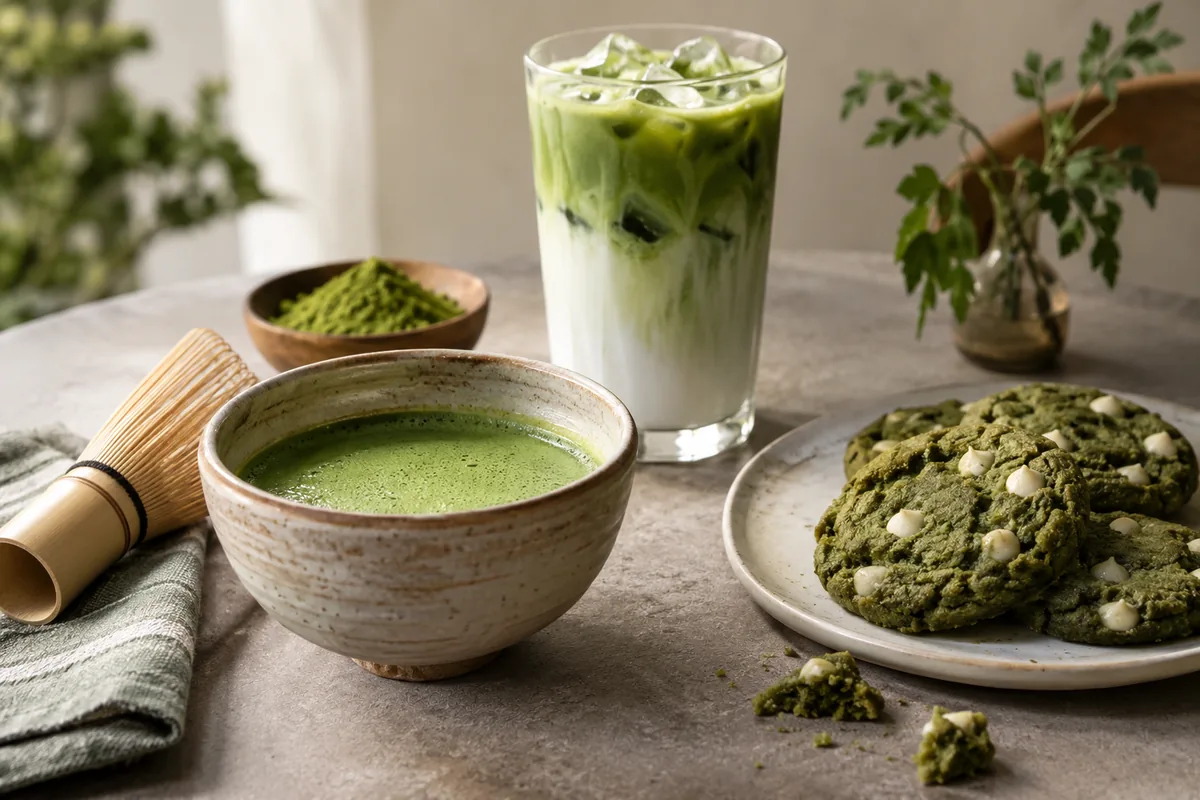
In my experience advising brands, the biggest source of confusion comes from matcha "grades." Terms like Ceremonial, Premium, and Culinary are marketing labels, not standardized industrial specifications.3 A more productive way to think of them is as job descriptions. Your job is to write the job description first, then find the candidate that fits.
A good OEM supplier acts as a consultant, helping you move past these labels to focus on the performance metrics that matter for your application.
H3: Start with Your Application
Before you even type "matcha supplier" into a search bar, answer these questions:
- What is the primary way my customer will consume this product? (e.g., whisked with water, blended into a latte, baked into a cookie)
- What is the most important sensory attribute for that experience? (e.g., smooth umami flavor, vibrant green color in milk, strong matcha flavor after baking)
- What is my target cost-of-goods for this application? (A ceremonial tea can support a higher cost than a culinary ingredient).
Here’s a breakdown of how we guide clients to think about grades based on their end product:
| Product Application | Common "Grade" | Key Performance Metrics to Discuss with an OEM Supplier |
|---|---|---|
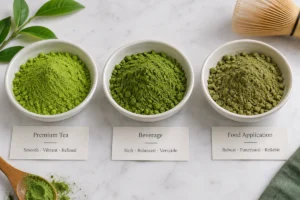
| Pure Tea / Premium Tea Brand | Ceremonial Grade | Umami & Sweetness: Low bitterness is non-negotiable. Fine Particle Size: Ensures a smooth, non-gritty mouthfeel. Vibrant Color: Bright green is a key visual indicator of quality. |
| Matcha Latte / Cafe Chain | Premium / Barista Grade | Color Stability in Milk: How green does it stay when mixed? Flavor Strength: Must be robust enough to stand up to milk and sweeteners. Cost-Effectiveness: Must fit into a profitable beverage menu. |
| Baking / Food Manufacturing | Culinary Grade | Heat Stability: Does the color and flavor survive the oven? Astringency: A little bitterness can add depth and cut through sweetness in desserts. Batch Consistency: Essential for repeatable results in a commercial kitchen. |
Instead of asking a potential OEM supplier for a grade, try asking a performance-based question. For example: "I am developing a matcha latte for my cafe. I need a powder that produces a vibrant green color when mixed with oat milk and has a strong enough flavor to balance a touch of vanilla syrup, at a target cost of X per serving."
This immediately tells the supplier what you value and allows them to recommend a product based on performance, not just a marketing term.
What Should You Evaluate in an OEM Supplier's Process?
You’ve found a supplier whose matcha powder seems perfect in a sample test. But is that enough? Many brands fixate on the powder itself, forgetting that for an OEM product line, the matcha is just one component. You are buying a manufacturing partnership.
A great sample is a poor indicator of a successful partnership if the supplier’s process is a bad fit. The right OEM supplier is one whose MOQ, packaging capabilities, and sample testing process align with your business scale and speed-to-market needs.

Dive Deeper: You're Buying a Partnership, Not Just a Powder
When we begin discussions with a new brand, the conversation quickly moves from the matcha itself to how we can work together. This collaborative process is what you should be evaluating with equal, if not greater, weight than the physical sample.
Here are the key process-related factors to assess in a potential OEM supplier:
H3: The Sample Development & Testing Process A good partner doesn't just send you their "best" product. They engage in a dialogue.
- Consultative Approach: Do they ask questions about your application before sending samples? Or do they just send a price list?
- Iterative Feedback: Can you provide feedback on a sample (e.g., "This is good, but can we find something slightly less bitter?") and receive a new, adjusted sample?
- Application Testing: Do they encourage you to test the sample in your actual final recipe? I always advise clients to make the latte or bake the cookie before making a decision. The performance in the final application is the only test that matters.
H3: Alignment on Business Scale (MOQ & Capacity) Minimum Order Quantity (MOQ) isn't just a number; it's a signal of the supplier's business model.4
- Low MOQ: A supplier with a low MOQ (e.g., 20-50 kg) is likely geared toward helping new brands and startups launch.5 This is great for market testing but be sure to ask about their ability to scale. Can they handle an order 10x that size if you succeed?
- High MOQ: A supplier with a high MOQ (e.g., 500+ kg) is structured to serve large-scale manufacturers and distributors. They may offer better pricing but are a poor fit for a brand that only needs to produce a few thousand units for its first run.
H3: Packaging & Private Label Capabilities Your OEM supplier is your production arm. Their capabilities (or lack thereof) directly impact your final product.
- Packaging Options: Do they offer the specific format you need? (e.g., retail pouches, bulk bags, single-serve sachets). Do they have experience with the required materials?
- Design & Compliance: Can they provide accurate die-lines for your designer? Are they familiar with labeling requirements for your target market (e.g., FDA, EFSA)? While compliance is ultimately your responsibility, an experienced partner can make the process much smoother.
- Communication & Project Management: How responsive and clear are they in communication? A dedicated contact person who understands your project is invaluable.
Choosing a partner whose processes match your current scale and future ambitions is the key to a smooth launch.
Is Your First OEM Supplier Meant to Be a Permanent Partner?
You've put immense effort into finding the right supplier, and the idea of repeating the process is exhausting. So, you might be tempted to find one partner you can stick with forever, for every product you ever launch. This can be a strategic mistake.
The primary goal of your first OEM partnership is market validation. The biggest risk for a new product line isn't choosing a slightly-too-bitter matcha; it's a complete supply chain failure or partnering with a supplier who cannot scale with your success.6
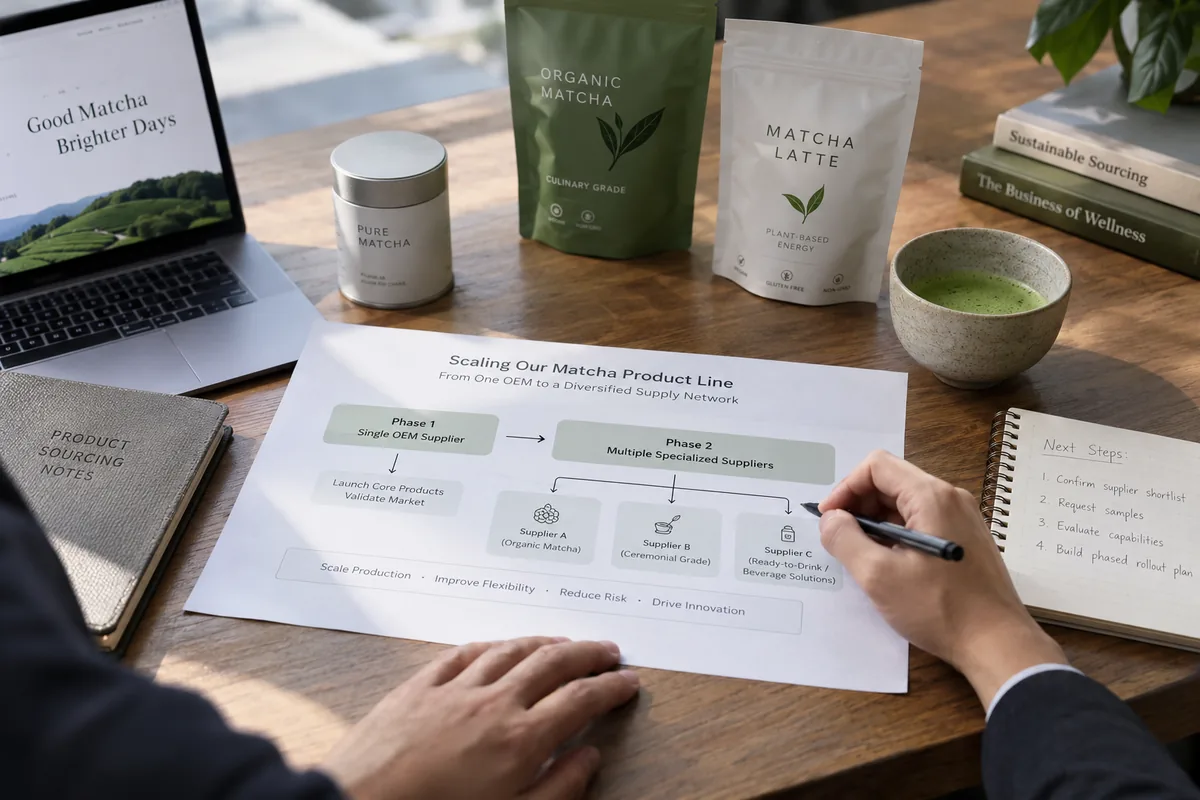
Dive Deeper: The Market Validation Supplier Strategy
Think of your first OEM supplier as your "market validation partner." Their job is to provide a reliable, quality product that allows you to test your concept in the real world with minimal initial risk. This mindset changes how you evaluate them.
H3: De-Risking the Launch Your first priority is getting a quality product onto the market to see if customers will buy it.7
- Reliability over "Perfection": A supplier who ships on time and provides consistent quality is more valuable for a launch than a supplier with the "perfect" matcha but an unreliable production schedule.
- Focus on the Core Product: Concentrate on launching your hero product first. Don't try to build a full line of five different matcha products with one supplier from day one. Launch one, gather data, and then expand.
H3: Understanding Single-Source Risk Relying on a single OEM supplier for everything introduces significant risk. What happens if they have a production issue, a raw material shortage, or a sudden change in their business strategy? Your entire product line is vulnerable.
- The 80/20 Rule: A good starting strategy is to place around 80% of your initial volume with your primary market validation partner.
- Developing a Secondary Source: As soon as you have proven market demand, you should begin the process of qualifying a secondary supplier. This new partner doesn't need to replace your first one; they can be a backup or a specialist for a future product. For instance, if your first supplier is excellent at barista-grade matcha for your lattes, you might seek a different specialist for a high-end ceremonial grade you plan to launch next year.
H3: Scaling Your Supply Chain with Your Brand As your brand grows, your needs will evolve.8
- Phase 1 (Launch): Your primary need is a reliable OEM supplier with a reasonable MOQ to help you test the market.
- Phase 2 (Growth): You have consistent sales. Your need shifts to cost optimization, volume capacity, and mitigating supply chain risk by qualifying a second supplier.
- Phase 3 (Expansion): You are launching new product categories (e.g., adding baked goods to your beverage line). Your need is for specialized suppliers who are experts in those specific applications (e.g., a culinary grade specialist).
Viewing your first supplier partnership as a strategic starting point, not a lifelong marriage, frees you to make the best decision for right now, while keeping your options open for a more complex and resilient supply chain in the future.
Frequently Asked Questions
What's the difference between OEM and private label for matcha?
OEM (Original Equipment Manufacturer) is a broad term where a factory produces goods that are marketed by another company. Private label is a specific type of OEM service where the supplier produces a product (like matcha) that you then sell under your own brand name. At Lvyinbio, we offer private label services as part of our OEM capabilities.
How important is a supplier's country of origin?
While Japan is famous for matcha9, China is a major producer of high-quality matcha, especially from regions like Guizhou.10 The key is not the country, but the supplier's specific region, farming practices, and processing capabilities. We recommend always evaluating samples and requesting product specification sheets to assess quality, regardless of origin.
What is a reasonable MOQ for a first OEM matcha order?
A reasonable MOQ depends on the supplier's scale. For a startup-friendly OEM supplier, an initial order between 20 kg and 100 kg is common. This allows you to produce a significant first batch for market testing without a massive upfront investment. Larger, more industrial suppliers may have MOQs of 500 kg or more.
Should I be worried if an OEM supplier specializes in just one grade of matcha?
Not at all. In fact, specialization can be a sign of expertise. A supplier who is a true master of ceremonial grade may be the perfect partner for a premium tea brand. The key is to match their specialty to your product's needs. A supplier claiming to be the best at everything should be scrutinized more carefully.11
Conclusion
Successfully building a matcha product line begins with a strategic shift in mindset. Stop the exhaustive search for one perfect, lifelong partner. Instead, focus on finding the right OEM supplier for your immediate launch. This means clearly defining your initial product and its core application, evaluating a potential partner's collaborative process just as much as their powder, and understanding that this first partnership is a critical step for market validation. By choosing a reliable supplier to help you get to market, you de-risk your launch and gather the data needed to build a resilient, scalable supply chain for the future.
If you are developing a matcha product and need a partner to help you navigate these decisions, we're here to help. Contact us to discuss your product concept, and we can guide you toward the right grade and plan for a successful launch.
"Understanding ODM Suppliers: Are They Right for Your ...", https://www.epowercorp.com/single-post/understanding-odm-suppliers-are-they-right-for-your-product. Research on OEM supplier strategies suggests that aligning supplier capabilities with product requirements can streamline market entry and reduce initial risks for startups. Evidence role: general_support; source type: research. Supports: Using a single OEM supplier can be an effective strategy for initial market launches when their capabilities align with the product's needs.. Scope note: The effectiveness of this strategy may vary depending on the industry and product type. ↩
"Matcha vs Matcha Latte : r/MatchaEverything", https://www.reddit.com/r/MatchaEverything/comments/1j4xdzg/matcha_vs_matcha_latte/. Studies on matcha applications highlight that suppliers often specialize in specific product types, such as ceremonial tea or latte-grade matcha, to meet varying performance requirements. Evidence role: general_support; source type: research. Supports: Different matcha applications, such as ceremonial tea and lattes, require distinct supplier expertise and product characteristics.. Scope note: The degree of specialization may depend on the supplier's production capabilities. ↩
"Matcha Grades Explained: Is “Ceremonial Grade” Always ...", https://senchoju.com/blogs/latest-news-updates/matcha-grades-explained-is-ceremonial-grade-always-real?srsltid=AU7gw4W1FMBRbt-dQaN_IfpJPLZiMXI2yKPDALzjaSWwIMKaxgsIlzfW. Educational resources on matcha production confirm that terms like Ceremonial, Premium, and Culinary are commonly used as marketing labels rather than standardized grades. Evidence role: definition; source type: education. Supports: Matcha grades such as Ceremonial, Premium, and Culinary are not standardized industrial specifications but are marketing terms.. Scope note: The lack of standardization may vary by region or producer. ↩
"MOQ Meaning In Supply Chain: Formula, Benefits & Best ...", https://www.agilescs.com/blog/moq-meaning. Educational materials on supplier selection explain that MOQ often reflects a supplier's target market and production scale. Evidence role: mechanism; source type: education. Supports: MOQ can indicate a supplier's business model, such as whether they cater to startups or large-scale manufacturers.. Scope note: The interpretation of MOQ may vary across industries. ↩
"Clothing Manufacturers for Startups: Low MOQ Explained", https://www.madeapparelservices.com/blog/clothing-manufacturers-for-startups?srsltid=AU7gw4U2EMgR0B1ZFbg3JFvkQEFUEvIk02cmDJiXYj12Sw6yXIOH6bPe. Research on supplier practices indicates that low MOQ offerings are typically designed to accommodate the needs of startups and small-scale operations. Evidence role: general_support; source type: research. Supports: Low MOQ suppliers are often structured to support startups and new brands.. Scope note: This may not apply to all suppliers, as some may offer low MOQs for other strategic reasons. ↩
"Success Stories: Case Studies in Supply Chain Engagement", https://19january2021snapshot.epa.gov/climateleadership/success-stories-case-studies-supply-chain-engagement_.html. Studies on supply chain management highlight that scalability and reliability are critical factors for the success of new product launches. Evidence role: general_support; source type: research. Supports: Supply chain failure and lack of scalability are significant risks for new product lines.. Scope note: The relative importance of these risks may vary by industry. ↩
"5 Steps to Validate Your Business Idea", https://online.hbs.edu/blog/post/market-validation. Educational resources on product development emphasize the importance of market validation to assess customer demand before scaling production. Evidence role: general_support; source type: education. Supports: Market validation is a critical first step in launching a new product.. Scope note: The priority of market validation may depend on the product and market context. ↩
"The Evolution of Supply Chain Management and Its Future", https://www.amu.apus.edu/area-of-study/business-administration-and-management/resources/the-evolution-of-supply-chain-management/. Educational materials on business growth highlight that evolving needs, such as increased production capacity and cost optimization, are common as brands scale. Evidence role: general_support; source type: education. Supports: Brand needs evolve as they grow, requiring adjustments in supply chain strategies.. Scope note: The specific needs may vary depending on the brand's industry and growth trajectory. ↩
"Matcha", https://en.wikipedia.org/wiki/Matcha. Encyclopedic entries on Japanese tea culture confirm that Japan is globally recognized for its high-quality matcha and traditional tea practices. Evidence role: historical_context; source type: encyclopedia. Supports: Japan is renowned for its matcha production and cultural association with the tea.. ↩
"Matcha", https://en.wikipedia.org/wiki/Matcha. Encyclopedic entries on global tea production confirm that China, particularly regions like Guizhou, is known for producing high-quality matcha. Evidence role: statistic; source type: encyclopedia. Supports: China, including regions like Guizhou, is a significant producer of high-quality matcha.. Scope note: Quality assessments may vary based on specific producers and farming practices. ↩
"Risk factors in the assessment of suppliers - PMC - NIH", https://pmc.ncbi.nlm.nih.gov/articles/PMC9342744/. Research on supplier evaluation emphasizes the importance of verifying claims of broad expertise to avoid potential mismatches in capabilities. Evidence role: expert_consensus; source type: research. Supports: Suppliers claiming expertise in all areas should be scrutinized to ensure they meet specific product requirements.. Scope note: The need for scrutiny may depend on the complexity of the product. ↩